
What’s Next? News leaders discuss AI, Disinformation and Ethical Challenges
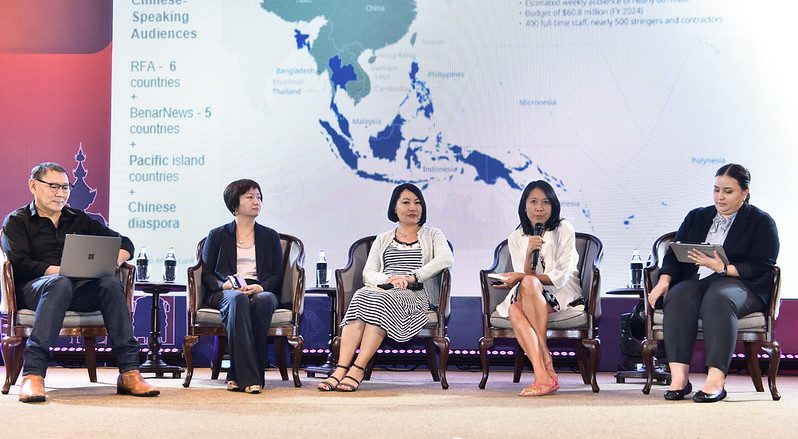
“AI is not just a tool; it’s a revolution in the making,” declared Zhang Shilei, Director at CGTN Digital during the final panel discussion at the 2024 Global News Forum. The panel was tasked with crystallising thoughts on a range of issues discussed during the day.
Zhang emphasized the transformative potential of AI in content creation while also stressing the need to manage its use carefully to avoid biases. “We see AI as a tool of revolution rather than a revolution of tool,” Shilei added.
Assel Mussagaliyeva-Tang, Founder of EDUTech Future & Microsoft in Education Global Training, highlighted concerns about AI ethics and governance. “The biggest problem right now out of all the issues with Large Language Models (LLM) development is algorithmic bias,” Assel stated. “Algorithms really represent how unfair our world is. We need to understand where AI ethics, bias, and governance come from — is it the person training the models, the person labelling data, or the software engineer? Who is responsible when the data leaves the lab and reaches the public?”
Bay Fang, President of Radio Free Asia, echoed these concerns, and stressed the need for rigorous editorial standards. “We need to ensure that our editorial integrity is maintained. The future of journalism lies in pushing back against disinformation both quickly and deeply,” Bay said.
Bay shared an example of RFA’s work. “During the Maui wildfires last year, there was disinformation spreading in Mandarin social media claiming the fires were caused by a US weapons test.” She highlighted the role of the Asia Fact Check Lab, which was established to tackle disinformation. “Our team investigated, did a reverse image search and found that the videos were actually from a windstorm in Louisiana from 2018. This kind of fact-checking is crucial in today’s media environment,” said Bay.
Joe Hironaka, Chief of Communication and Information at UNESCO Bangkok, stressed the importance of media literacy and debunking misinformation. UNESCO has media and information literary programs based on critical thinking and a human rights-based approach.
Using media literacy to counter disinformation
The discussion also touched on the need for broader solutions and international collaboration. Joe highlighted UNESCO’s recent initiatives: “UNESCO has developed the first international normative instrument for the ethics of AI, including its impact on media. This is crucial for maintaining a balance in the digital age.”
Joe emphasized that media literacy is vital for addressing misinformation. “Media literacy programs based on critical thinking and human rights approaches are essential. It’s about preparing people to assess news and information independently,” he said.
Opportunities in Multilingual and Cultural Reporting
Another key topic was the challenge of multilingual reporting and the preservation of languages. Joe highlighted the need to address language extinction. “There are over 7,000 languages in the world, with around 4,000 in Asia Pacific alone. Many of these languages are facing extinction. AI can play a role in preserving these languages, but we must act quickly,” Joe noted.
The discussion also touched on the importance of diversifying news coverage. “There’s no excuse to silo reporting in just one language,” said Joe. “We must respect linguistic diversity and ensure our news reaches a global audience.”
According to recent data from Facebook, Shilei said, “70 percent of young people on Facebook long for a greater variety of culture in their media consumption,” highlighting a growing demand for diverse perspectives and content.
Ethical Considerations and Future Directions
The panelists agreed on the importance of upholding core journalism ethics as newsrooms adopt new technologies and respond to regulatory challenges. “Regardless of the tools we use, the core values of journalism — accuracy, fairness, and accountability — remain unchanged,” emphasized Bay.
“We must navigate the complexities of digital governance while respecting diverse regulatory environments,” said Shilei. “Our goal is to create value for our users and provide information that can be verified and trusted.”
As the forum concluded, the message was clear: the future of news will depend on the industry’s ability to balance innovation, new technologies and new opportunities with rigorous ethical standards and a renewed commitment to accurate, unbiased reporting.