
Social and Video Networks Gain Ground as News Sources Worldwide
The reliance on social and video networks as primary news sources is rising across countries, according to the Reuters Institute Digital News Report 2025.
Brazil (35%), the United States (34%), and Singapore (30%) show higher dependence on these platforms compared with the United Kingdom (20%), France (19%), Denmark (12%), and Japan (10%).

Figure 1: Reliance of social and video networks. Q4. You say you’ve used these sources of news in the last week, which would you say is your main source of news? – Reuters Institute Digital News Report 2025
In Singapore, younger audiences aged 18 – 44 are turning to social media and video platforms alongside online news sites and apps, with usage significantly higher than for other formats. Reuters’ Jim Egan notes a similar trend in the Philippines, although television continues to play a major role in news dissemination there.

Figure 2 Main source by age – Singapore Q4. You say you’ve used these sources of news in the last week, which would you say is your main source of news? – Reuters Institute Digital News Report 2025

Figure 3 Main source by age – Philippines Q4. You say you’ve used these sources of news in the last week, which would you say is your main source of news? – Reuters Institute Digital News Report 2025
TikTok’s News Audience Expands Globally
Globally, a third (33%) of the sample use TikTok for any purpose, and over half of these users (17%) turn to it for news. The fastest growth is in Thailand, where 49% now use TikTok for news — a 10-percentage-point increase over last year.

Figure 4 Audience using TikTok based on country. Reuters Institute Digital News Report 2025
Uptake is also increasing in other regions, particularly among younger groups. In contrast, TikTok news usage remains lower in the United States (12%) and Europe overall (11%).
YouTube a Key Player in Emerging Markets
In India, Thailand, and Kenya, half of the surveyed audience report using YouTube for news. The platform’s popularity in these countries is linked to cheap mobile data and lower literacy rates, making video formats more accessible.
Challenges for Traditional Media
The dominance of video networks presents challenges for traditional news organisations. Facebook, originally built around social connections, now competes with YouTube and TikTok, which are driven by creator-led content. Creators draw the majority of attention on these platforms, while traditional outlets struggle to adapt journalistic content to informal spaces. Publishers also fear losing website traffic by posting on networks not optimised for referral clicks.
Text Still Preferred, But Viewing on the Rise
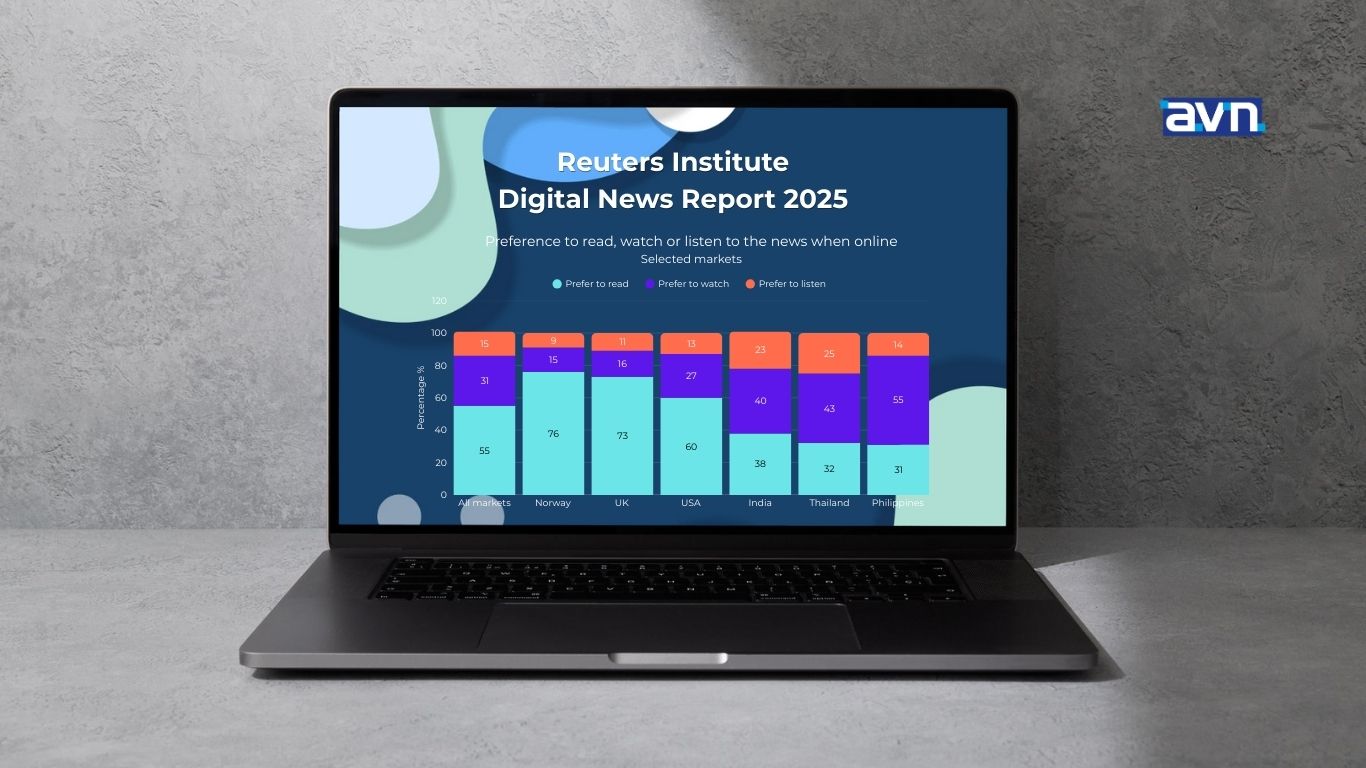
Despite the growth of video, 55% of audiences across all markets still prefer to read news online, citing speed and control as key advantages. Around 31% prefer to watch news online, while 15% opt for listening. Preferences vary widely by country: audiences in India, Mexico, and the Philippines lean toward watching, whereas readers dominate in Norway, Germany, and the UK.

Figure 5 Proportion that prefer to read, watch or listen to online news – selected markets. Reuters Institute Digital News Report 2025
Misinformation Concerns Remain High
Concerns about online misinformation remain significant. In the Asia-Pacific region, 60% say they worry about distinguishing between real and fake content, closely aligned with the 58% global average. In Asia, politicians or political parties as well as influencers are seen as the biggest threat.

Figure 6 Who is seen as the biggest threat when it comes to creating damaging misinformation? Reuters Institute Digital News Report 2025
Across markets, Facebook and TikTok are viewed as the biggest misinformation threats. Facebook has long been at the centre of public concern, but TikTok has now overtaken several older platforms in this regard. In the Philippines, 68% see Facebook as a major source of mis- or disinformation, while in India, 58% point to WhatsApp as the main culprit.
But, The News Avoidance Is The Real Issue
According to the report, top three reasons from the survey are: the news has effect on mood (39%), they are worn out by the amount of news (31%) and there is too much coverage of conflict or war (30%).

Figure 7 Reason for avoidance. Reuters Institute Digital News Report 2025
Younger people tend to avoid news because for them it is harder to follow or understand. Take for example people under the age of 35 in Malaysia (25%), Thailand (19%), Philippines (16%) avoid the news because it is too hard to follow or understand as compared with people above 35 years old.

Figure 8 Proportion that avoid the news because it is too hard to follow or understand Q1di_2017ii. Why do you find yourself actively trying to avoid the news? Reuters Institute Digital News Report 2025
The news and media landscape is shifting rapidly. Public broadcasters, in particular, must adapt or risk being left behind, trapped in a time capsule.