
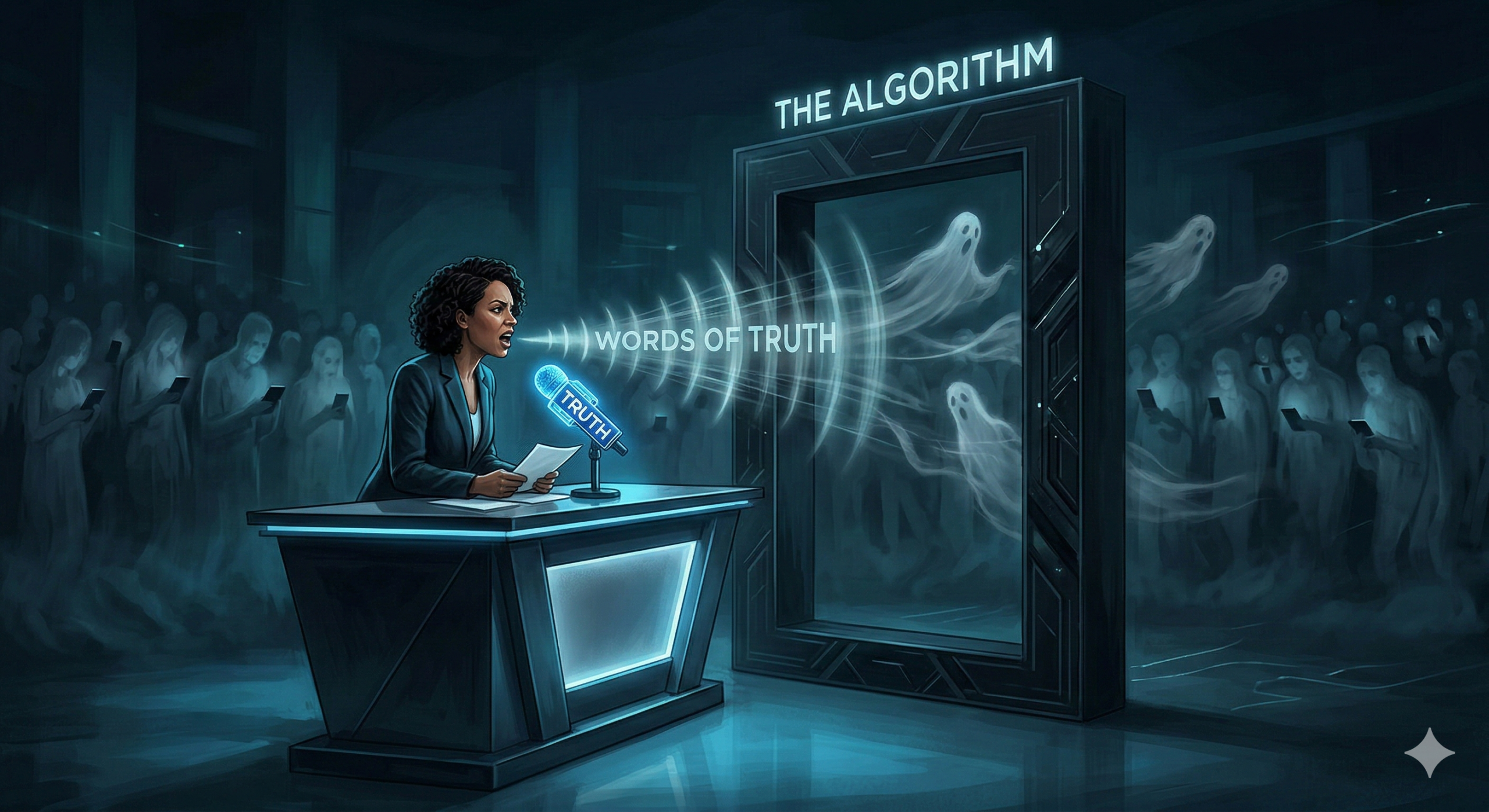

Shadow banned: When algorithms quietly silence journalism
Imagine publishing your most vital investigation—a story of global consequence—only to watch it silently sink into obscurity. You haven’t been banned, your account isn’t suspended, and you have received no violation notifications. Yet, your reach has plummeted to zero. You have entered the “communicative limbo” of the shadow ban, a form of “social erasure” where you speak into a void and your presence fades without a trace.
For many journalists, the most frustrating challenge today is the shadow ban. Unlike a typical ban, shadow banning is a “silent censorship.” Your content stays online, but the algorithm hides it from your followers’ feeds and search results without notifying you.
During a recent Asia-Pacific Broadcasting Union (ABU) Media Academy webinar, Hasan Durmaz, news editor at TRT Haber, explained how this shift reflects a broader transformation in newsroom power dynamics. “The editorial agenda that used to be determined by editors is now being shaped by algorithms,” Durmaz said.
As 65 percent of news followers now consume news online, editorial visibility increasingly depends on platform systems designed to prioritise engagement signals over accuracy. For news organisations reporting on conflict, extremism, or humanitarian crises, this creates a structural vulnerability where the public interest can be algorithmically suppressed without warning.
Durmaz shared that TRT Haber faced this during their coverage of Gaza. “When we reported on the Israeli army targeting children, we were restricted,” Durmaz explained. Content was often flagged as “hate speech” or “violence against children.” Newsrooms frequently face these restrictions without knowing the exact reason, effectively being blocked by platform owners and resulting in a declining audience reach without explanation.
According to Sada Social’s 2024 Digital Rights Index, 29 percent of all documented digital violations specifically targeted journalists and media institutions. This suppression occurs just as newsrooms are forced to adapt to the “attention economy,” where news competes with entertainment clips for an audience with a “two-minute attention span.”
While newsrooms face pressure to integrate AI into workflows to increase speed, audience trust in automation remains limited. A study by Financial Narrative found that only 12 percent of readers are comfortable with fully AI-generated news, while 90 percent expect disclosure when AI tools are used. Similarly, Gartner reported that nearly 60 percent of organisations saw reduced engagement in campaigns heavily driven by automation.
Newsrooms must balance algorithmic compliance, production speed, and editorial credibility to remain visible—particularly as platforms accelerate automation while audiences, amid growing “AI fatigue,” crave human authenticity. To survive this transition, journalists must treat technology as a support system, not a replacement. As Durmaz emphasised, “We still use artificial intelligence tools as passive instruments… to ensure that the final word always belongs to the editor.”
Expert tips to protect your reach:
- Avoid “bot-like” behavior: Do not post too frequently or use identical hashtags in every post; automated systems flag these patterns as spam.
- Monitor engagement: Watch for sudden, sharp drops in views via platform analytics; this is often the first sign of a shadow ban.
- Use “Algospeak”: Some reporters use coded language (such as “P@l3stin3”) to slip past automated filters while remaining intelligible to their audience.
- Invest in literacy: Build “algorithmic literacy” to understand the functions and ethics of the tools you use.
When asked if news will ever become 100 percent automated, Durmaz responded that as a public broadcaster, they do not yet trust AI for full workflows. “Speed can be lost, but once trust is lost, it is much harder to recover,” Durmaz stated. By reclaiming the role of the journalist as an ethical filter, we can ensure journalism remains a vital light for the public interest.
Written by: Nerina Rosli
*Meme was AI-generated.