
Op-Ed: In the age of social media, professional judgement has lost its pause
There was a time when professional dissatisfaction required effort.
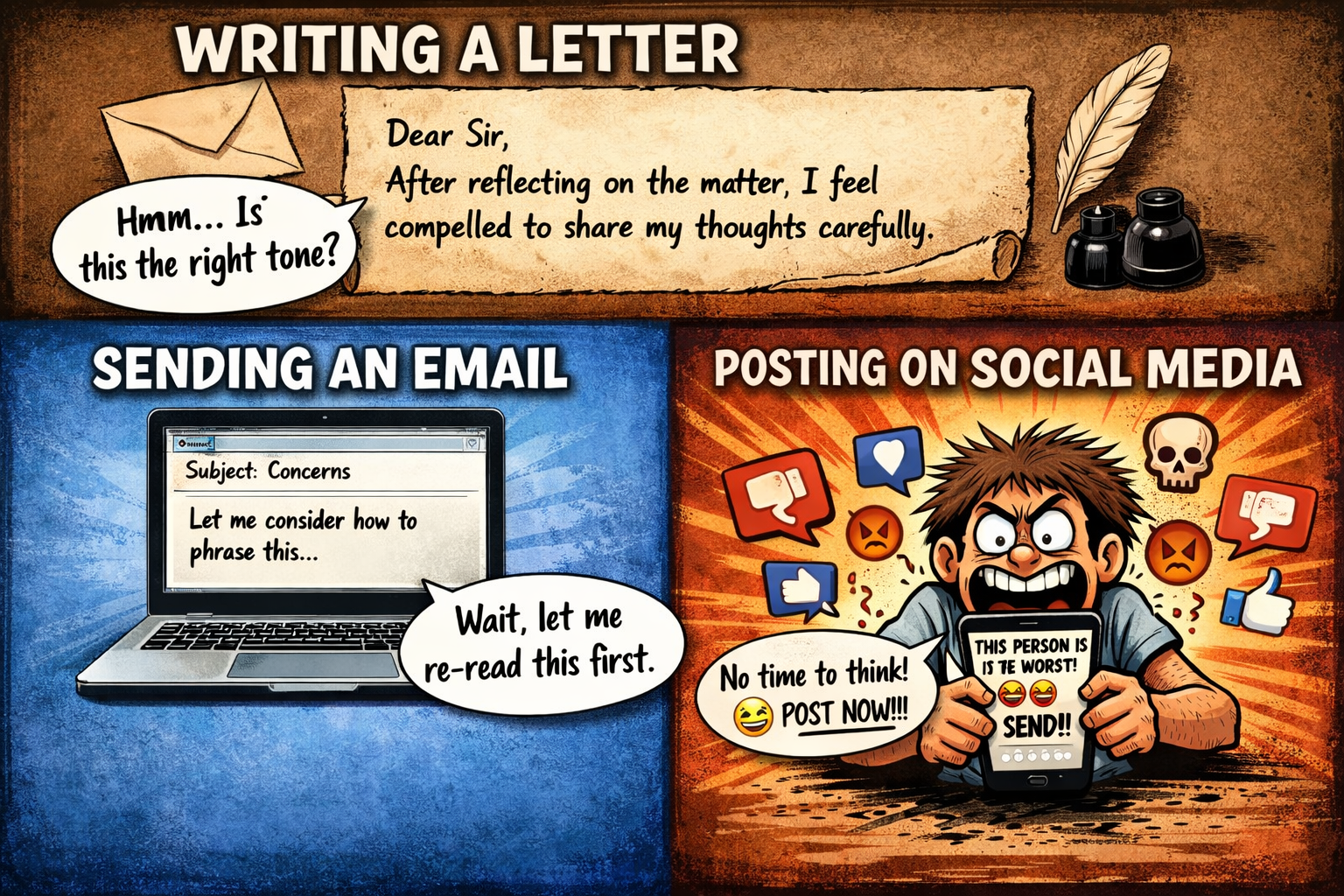
Criticism meant writing a letter. It involved drafting, revising, sealing an envelope, and waiting. Somewhere in that process, emotions often cooled. Many letters were never sent.
That pause mattered, particularly in professions built on judgment.
Today, criticism takes seconds. A thought becomes a post. Emotion becomes a public record. And the consequences: ethical, psychological, and reputational, are often considered only after the damage is done.
For journalism, this shift raises an uncomfortable question: have our professional ethics kept pace with our platforms?
When digital critique becomes ethical failure
In recent years, several documented cases within the media industry highlighted a recurring pattern: professionals in public-facing roles withdrawing from professional or digital spaces after being subjected to sustained online criticism.
In several instances, what began as disagreement escalated into public collective criticism: amplified through reposts, likes, and affirming commentary from peers.
These cases were not controversial because dissent existed. Disagreement is foundational to journalism.
They were controversial because of how that disagreement unfolded: publicly, rapidly, and without proportion or restraint.
From an ethical standpoint, the issue is not opinion, it is process. What once might have been handled through internal discussion, editorial review, or direct communication instead played out in real time before an audience, stripped of context and insulated from accountability.
No pause. No cooling-off period. No private dialogue before public judgment.
This is not about disagreement, it’s about behaviour
Public visibility invites public reaction. Anyone who puts their work into the world: as a journalist, editor, spokesperson, or analyst, understands that scrutiny comes with the territory. Praise and criticism are part of professional life.
But there is a clear distinction between constructive critique and public shaming.
Constructive critique seeks clarity or improvement.
Public shaming often seeks affirmation from an audience rather than resolution.
What makes recent cases troubling is not the presence of criticism, but its delivery: often by peers and senior professionals who understand, better than most, the power of words. In journalism, seniority is frequently equated with refined judgment. Social media has exposed how fragile that assumption can be.
American political philosopher Hannah Arendt warned that harm is often enabled not by malice, but by thoughtlessness. Platforms optimised for speed and visibility reward reaction over reflection. This is a troubling trade-off for a profession built on careful judgment.
Cyberbullying is a media ethics issue, not a youth issue
Cyberbullying is still commonly framed as a problem affecting teenagers. Research from the past five years challenges this narrative.
Studies consistently show that online harassment affects adults across professions, with links to anxiety, stress, repeated self-questioning, and diminished psychological safety. Particularly when criticism is public and socially reinforced. For media professionals, the impact extends beyond mental health to professional confidence, editorial judgment, and willingness to take risks.
This should concern journalism.
A profession that depends on critical thinking cannot thrive in environments where visibility is punished through public shaming and public criticism endorsed by peers.
What we lost when we lost the pause
The traditional complaint letter demanded intention. Time slowed emotion. Distance created perspective.
Social media makes reacting easier than reflecting.
Canadian philosopher Marshall McLuhan’s observation that “the medium is the message” remains relevant. Platforms designed for immediacy shape behaviour: reaction replaces reflection; performance replaces dialogue.
What disappears is the ethical pause? Ask yourself:
- Is this necessary?
- Is this fair?
- Should this be said privately rather than publicly?
That pause is not about politeness. It is about professionalism.
Personal platforms are not ethical vacuums
Journalists often argue that personal social media accounts exist outside professional scrutiny. In reality, this rarely works that way.
When names, roles, affiliations, and seniority are publicly visible, online behaviour carries professional weight, regardless of intent. What is posted, liked, or amplified signals values. It shapes newsroom culture. It sets norms for those watching closely, particularly younger journalists.
Ethical responsibility does not end when the byline disappears.
Criticism is normal. Care is a choice.
Public-facing work invites public commentary. Some reactions will be supportive; others critical. That is unavoidable and often healthy.
What is not inevitable is how criticism is expressed.
Private feedback invites accountability and growth.
Public pile-ons invite silence and withdrawal.
As journalism navigates declining trust and increasing hostility, ethical consistency matters more than ever. A profession that demands responsibility from others cannot afford to abandon restraint in its own digital conduct.
Before pressing “post,” it is worth remembering the letters that were never mailed and the pause that once prevented unnecessary harm.
Because in journalism, how something is said often matters as much as what is said.
*Meme was AI-generated.
Written by: Nerina Rosli