
Newsroom leaders urged to adopt journalism students
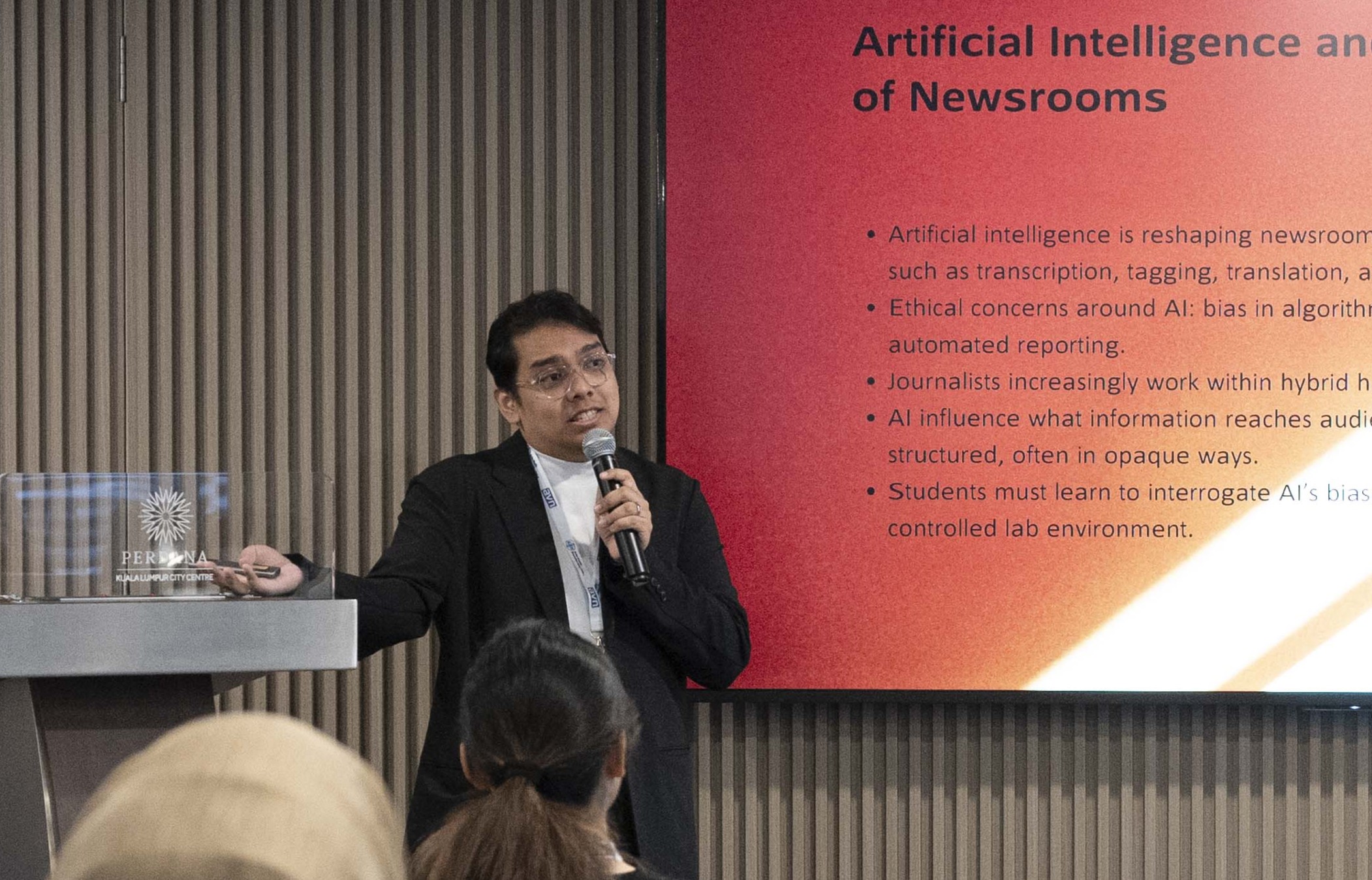
“When you return to your countries, please adopt journalism students and institutions,” urged Dr Muhammad Naim Muhamad Ali, a lecturer at the School of Communication and Creative Arts, University of Wollongong (UOW) Malaysia.
At the 2026 Asiavision Coordinators’ Meeting in Kuala Lumpur, he addressed global newsroom leaders, editors and journalists on the future of journalism education.
Dr Muhammad Naim argued that newsroom labs must be treated as a serious structural component of journalism education, rather than peripheral student activities, if graduates are to remain relevant in a rapidly evolving media environment.
“Even if you don’t have funding, mentorship and exposure from the industry make a huge difference,” he added.
A growing gap between theory and practice
Drawing on his experience as an academic, Dr Muhammad Naim acknowledged persistent industry concerns over graduates’ readiness for newsroom work.
“Journalists and media outlets often highlight the same issues: a lack of digital skills and difficulty identifying what is newsworthy,” he said. “Universities teach theories of news and angles, but it remains largely theoretical. Students can memorise, but they struggle to practise.”
He noted that the changing role of audiences has further complicated journalism education, with news consumers now also acting as content creators and contributors to news production.
Graduates competing with AI
A challenge, he said, is that graduates are now competing not only with each other, but with AI-generated content that can summarise, script and deliver information instantly.
“Students have to compete with AI, and at the same time learn how to use it,” he said. “They need to know how to prompt AI and how to use it responsibly.”
However, universities often discourage generative AI in classrooms to preserve critical thinking, a gap that leaves graduates underprepared for newsrooms where AI adoption is accelerating.
“We don’t encourage AI use because we want students to think critically,” he said. “But when they enter the industry, everyone is using AI. Universities have not yet equipped them with the right knowledge.”
Creative disruption, not gradual change
Describing the current moment as one of “creative disruption”, Dr Muhammad Naim said journalism is experiencing a cycle of dismantling and renewal rather than slow, incremental change.
The concept builds on the idea of creative destruction, first articulated by Austrian economist Joseph Schumpeter, who described how innovation repeatedly disrupts and replaces existing systems. Applied to journalism, creative disruption reflects how digital platforms and AI are reshaping not only production tools, but newsroom routines, content formats and audience relationships.
“What we practised 10 or 20 years ago cannot be practised now,” Dr Muhammad Naim said, pointing to shrinking attention spans, shorter content formats and the need to tailor stories across platforms rather than repurpose a single version of content for all channels.
He noted that audiences are no longer passive recipients of news, but active participants who comment, share and at times generate news content themselves. This shift challenges traditional newsroom hierarchies and editorial workflows.
In this environment, newsroom labs play a critical role, he argued, by providing media organisations with a protected space to experiment. Free from the daily pressures of deadlines and audience metrics, newsroom labs allow journalists and students to test new storytelling formats, explore cross-platform delivery, and refine audience engagement strategies while preserving editorial values and human judgment.
“Creative disruption does not mean abandoning journalism’s fundamentals,” he said. “It means rethinking how those fundamentals are practised in a digital and AI-driven environment.”
VoiceLah!: A newsroom lab model
At UOW Malaysia, Dr Muhammad Naim leads a newsroom lab known as VoiceLah!
VoiceLah! was designed to move beyond imitation of existing newsroom structures.
Imitation was a term Dr Muhammad Naim used to describe the replication of professional newsroom models without adapting them to new technologies, educational goals or local realities.
“Many newsroom labs are treated like student clubs, with one-off workshops,” he said. “Trainers come, deliver sessions, and leave without knowing whether students can apply what they’ve learned.”
VoiceLah! instead operates on a problem-based approach, giving students authority and autonomy to identify issues, develop content and find solutions independently. There are no grades or formal assessments, allowing students to experiment, fail and learn.
The lab also focuses on local reporting, encouraging students to cover issues relevant to their surrounding communities and amplify underrepresented voices.
Two years in university, one year in industry (2U1I)
Dr Muhammad Naim pointed to Malaysia’s 2U1I initiative, describing it as a promising but ultimately unsustainable programme.
“It was a good idea, but it should be designed to be a more meaningful project to cultivate necessary skills with media partners,” he explained.
He said newsroom labs could have provided a more sustainable foundation for such initiatives by embedding industry engagement into ongoing, supervised work.
A shared responsibility
Dr Muhammad Naim stressed that universities alone cannot prepare graduates for the realities of modern journalism.
“AI-generated content will always feel monotonous because it lacks human touch,” he said. “That is why we must teach students how to use AI properly and why news organisations must help shape the next generation of journalists.”
He added that adopting journalism students through mentorship and collaboration is also a practical way for media organisations to contribute to Sustainable Development Goals (SDG) 4: Quality Education, translating sustainability commitments into tangible action.
Written by: Nerina Rosli