
Legal & ethical responsibilities in news exchange
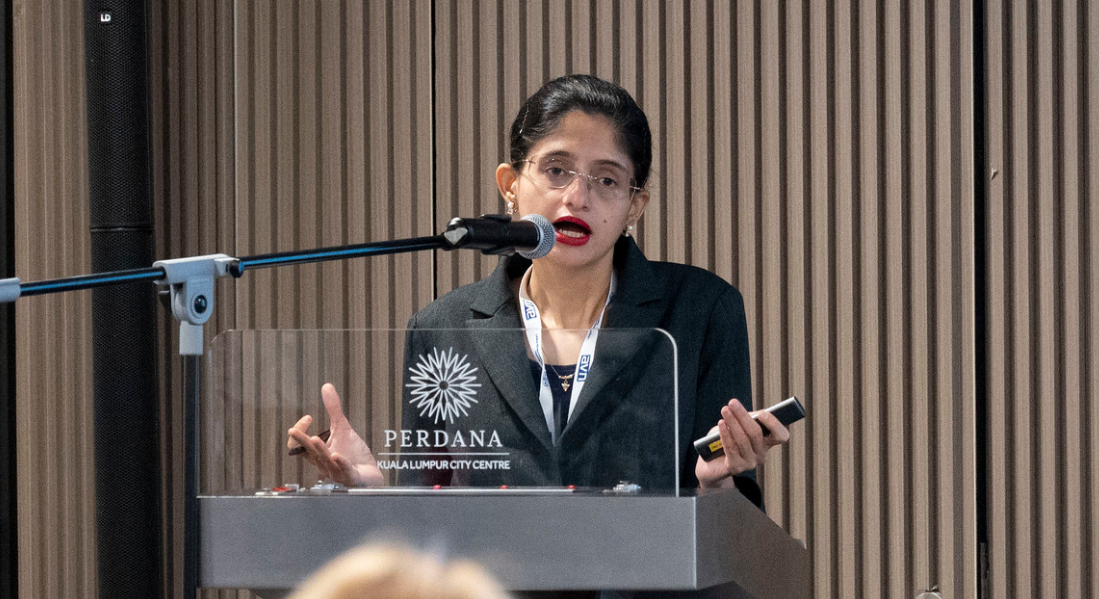
Legal compliance in news exchange is no longer solely a matter of copyright, but one that increasingly intersects with editorial ethics, professional trust and cross-border accountability, according to Dr Seemantani Sharma, Asia-Pacific Broadcasting Union (ABU) Legal Manager.
During the 2026 Asiavision Coordinators’ Meeting in Kuala Lumpur, she reminded editors and newsroom leaders on the growing legal and ethical complexities of content sharing across regional news networks.
She noted that while journalists deal daily with sound clips, images and written text, “many people still think about rights only in terms of copyright, when in reality rights management is fundamentally an issue of ethics for editors and journalists working in newsrooms.”
Copyright is territorial
Dr Sharma emphasised that although news now travels instantly across borders, copyright law does not. Each country applies its own legal framework, meaning content considered legally safe to be shared in one jurisdiction may not so in another.
“What happens in one country is immediately relevant elsewhere,” she said, “but copyright law itself remains territorial.”
She pointed out that certain countries provide specific exceptions for public service broadcasters, while others do not, creating potential exposure when content cleared for domestic use is uploaded to regional exchange platforms.
Shared platforms, shared liability
In collaborative news environments, liability does not rest solely with the original uploader. Dr Sharma explained that copyright law recognises both primary and secondary infringement, meaning that the organisation uploading content, the platform hosting it, and members downloading and using it could all face legal consequences.
“If due diligence is not carried out, all three parties may come under difficulty,” she said, noting that even unintentional infringement could result in cease-and-desist notices or takedown requests.
Permission & attribution are not interchangeable
Addressing a common newsroom misconception, Dr Sharma clarified that attribution alone does not replace permission.
“Crediting is not a substitute for permission,” she said, stressing that editors must both obtain rights clearance and provide proper attribution. While attribution is an essential editorial practice, it does not remove the obligation to secure permission from the rights holder.
Moral rights & editorial ethics
Dr Sharma highlighted the importance of moral rights, particularly in civil law jurisdictions across the Asia-Pacific region. Moral rights protect both attribution and the integrity of a work.
She explained that moral rights originate from the French legal tradition, where creative works are understood not merely as commercial property, but as an extension of the creator’s personality. This concept developed strongly in 19th-century France, shaping the idea that even when economic rights are licensed or transferred, creators retain enduring rights over how their work is attributed and represented.
As a result, moral rights protect two core principles: the right of attribution and the right to the integrity of the work. In many jurisdictions influenced by this tradition, these rights cannot be waived or transferred and remain permanently attached to the creator.
She explained that individuals who capture footage, especially eyewitnesses or local contributors, may not be motivated by financial gain but care deeply about authenticity. Editors were advised that heavy editing or contextual changes should only be done with consent.
She cautioned that heavy editing, reframing interviews, adding graphics or changing narrative context can affect the integrity of a work. While such actions may not always constitute copyright infringement, she noted that “when you alter the essence of a clip, it may not be a copyright problem, but it can very easily become an ethical problem.”
Dr Sharma also warned against removing or cropping attribution information, explaining that in many civil law jurisdictions, including countries such as China, Japan and Korea, proper attribution is treated as a legal and ethical obligation rather than a courtesy.
In shared news networks, she added, moral rights take on additional importance. Any distortion or misattribution introduced at the upload stage can be replicated across multiple organisations, potentially undermining trust and credibility across the network.
Social media content is not automatically cleared
Dr Sharma also cautioned against assuming that content sourced from social media platforms is free to use.
“Just because content is found on Google, Twitter, Facebook or YouTube does not mean it can be used freely,” she said, warning that uploading such material into shared networks exposes multiple organisations to legal risk.
Record-keeping in the age of AI
With the increasing use of AI-assisted tools in news production, Dr Sharma described record-keeping as increasingly essential. She urged newsrooms to document how content was produced, what sources were used, and how rights were cleared.
Until clearer legal guidance exists on copyright protection for AI-generated content, she said detailed documentation provides critical protection. While acknowledging that the process may feel bureaucratic, she noted that “record-keeping protects the organisation, the platform and other members.”
Editing & ethical boundaries
Dr Sharma shared scenarios where content reuse may be legally permissible but ethically questionable. She cited examples where material from another broadcaster is re-edited, reframed or contextualised in ways that alter meaning.
Such practices may not constitute copyright infringement, she said, but can undermine editorial integrity, particularly in sensitive stories.
Editors were advised to consider the following before uploading content for exchange.
A practical checklist for editors
- Who owns the footage
- Whether all elements are cleared for sharing
- Whether third-party materials are included
- Whether attribution is complete and accurate
- Whether territorial, time or platform restrictions apply
- Whether records are available to show where the content came from
If uncertainty remains, she advised editors not to upload the content and to seek clarification instead.
Coalition for Content Provenance and Authenticity (C2PA)
Dr Sharma highlighted emerging industry initiatives, “attribution may soon be built into the technology itself,” she said, adding that ethical practices adopted now will align newsrooms with future standards.
Industry initiatives such as the Coalition for Content Provenance and Authenticity (C2PA) aim to embed information about authorship, origin and edits directly into media files. Media and technology organisations, including Adobe, are working to ensure that attribution and edit histories travel with the content itself making content origins and edits increasingly traceable.
Protecting trust in news exchange
Dr Sharma stressed that the objective of these guidelines is not to restrict journalism, but to safeguard collaborative news environments.
“All members are guardians of the network’s integrity,” she said, highlighting the shared responsibility required to maintain trust, credibility and professionalism in regional news exchange.
Written by: Nerina Rosli