
Journalism, post-reality & the fight for meaning
“Ah, what a nice, intelligent question you are asking me,” said your AI chatbot. So, you want to stay with them the whole day.
That is the reality of today – and the central warning and challenge laid out by Kati Bremme, Head of Innovation and Editor-in-Chief of Meta-Media at France Télévisions.
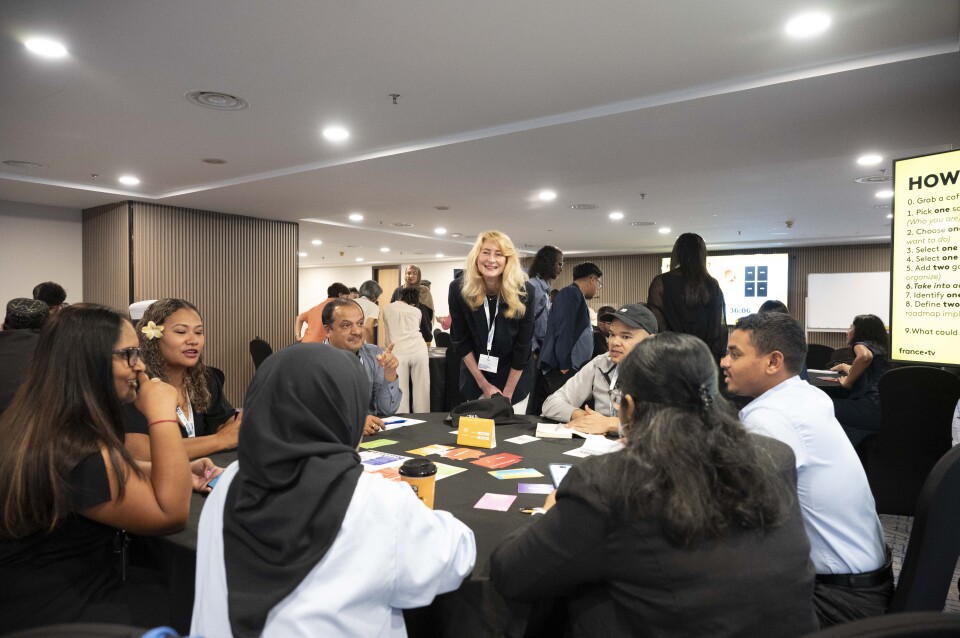
At the 2026 Asiavision Coordinators’ Meeting in Kuala Lumpur, Bremme examined how AI is reshaping not only newsroom workflows, but the very idea of truth, authorship, and meaning.
Journalism is no longer just competing with platforms; it is negotiating its place inside artificial intelligence itself.
The distinction matters. While generative AI is often framed as a tool for efficiency, Bremme argued that journalism is facing something far deeper: a “post-reality” moment where the authority of facts, sources, and even authorship itself is being destabilised.
Post-reality and the collapse of the original
“Welcome to post-reality,” Bremme said. “In this new time, people propose rewriting the entire corpus of human knowledge – adding missing information and deleting errors thanks to AI – according to their vision of the world.”
The idea echoes the work of French philosopher Jacques Derrida, who argued decades ago that meaning is never fixed but endlessly deferred – constructed through repetition, context, and interpretation rather than a single, stable origin. What AI does, Bremme suggested, is industrialise this process.
“In generative AI, there is no original,” she implied. “Only recombination.”
Large language models (LLMs) do not “know” truth; they predict language based on patterns. In Derridean terms, AI produces signifiers without origin – content without lived experience, intention, or accountability. For journalists, this raises a fundamental question: what happens to truth when meaning itself becomes synthetic?
From filter bubbles to intimacy machines
For years, newsrooms have focused on the “filter bubbles” created by social media. But Bremme argued that this concern is already outdated.
“2022 was the first year time spent on social media declined,” she said. “Not because people went back to walking in forests, but because they moved to AI channels.”
Citing the Reuters’ Digital News Report 2025, she noted, 15 percent of under-25s get their news from chatbots. Unlike social media, these systems create something new: a private, emotional, one-to-one relationship.
“You are not in a filter bubble anymore,” Bremme explained. “You are alone with your chatbot in a very intimate interaction.”
This phenomenon, described by Shuwei Fang, a researcher at the Harvard Kennedy School, as the “AI intimacy dividend,” poses a serious challenge for journalism. In these private AI interactions, users engage with information in isolation, meaning media brands may no longer be encountered socially or collectively – if at all.
“We, as media, need to find a place there, too,” Bremme said.
From search engines to answer engines
Discoverability, already fragile, is being structurally rewritten.
“Search engines are becoming answer engines,” Bremme said. “You no longer get a list of links. You get the answer.”
This takes journalism from a “zero-click” problem to what she described as “zero-question” territory, where AI systems proactively push content before users even ask.
In France, this has already forced strategic decisions. The newspaper Le Monde recently signed an agreement with Perplexity – not for traffic, but for visibility.
“The value is no longer in the click,” Bremme said. “It’s in being quoted – in appearing with your brand.”
Opting out, she warned, is largely theoretical. “You can choose to opt out of Search,” she recalled a Google executive saying. “But then you disappear.”
Accuracy, hallucinations and the ethics of authority
Presence comes with risk. Studies by the European Broadcasting Union (EBU), the British Broadcasting Corporation (BBC), and other public broadcasters show that AI-generated answers frequently contain errors and hallucinations. For public service media, Bremme argued, this is not merely a technical issue – it is an ethical one.
“Do we really need to use these technologies?” she asked. “And if we do, under what conditions?”
France Télévisions has chosen engagement with strict safeguards, including transparency when AI is used in editorial content – such as employing deepfake technology to protect the identities of vulnerable Iranian women in documentaries.
“But transparency alone is not enough,” Bremme stressed.
Moral rights
At the heart of Bremme’s argument was a concept deeply rooted in French legislation: moral rights.
Unlike copyright, moral rights protect the integrity, attribution, and intent of the author. Crucially, they cannot be sold or waived.
“Moral rights matter,” Bremme said, invoking a French model where being quoted accurately and credited properly is a core ethical principle, not a technical detail. In an AI ecosystem where content is summarised, remixed, and re-voiced without context, moral rights become a frontline defense for journalism.
“If AI uses our content,” she argued, “sources and attribution must still matter.”
This is why France Télévisions is implementing Coalition for Content Provenance and Authenticity (C2PA) certification: to ensure traceability and authenticity. However, Bremme cautioned that labels alone will fail without media literacy. “Otherwise,” she said, “it’s just a sticker.”
Reality? Who cares!
”There are younger generations who just do not care if something is real or not real: who are following virtual influencers and are happy to have something just for entertainment,” shared Bremme.
Virtual influencers, AI companions, and even AI marriages signal a cultural shift where authenticity is secondary to emotion. This is the true challenge of post-reality journalism: not simply falsehood, but indifference to truth.
From digital-first to AI-first
Inside newsrooms, Bremme warned journalists against treating AI as a shortcut.
“We keep asking: how do we plug AI into our Content Management System (CMS)?” she said. “But maybe tomorrow, we won’t need titles anymore.”
Instead, she urged journalists to ask deeper questions:
- What do people actually need from news?
- How do they want to engage with it?
- If we started from scratch today, what would we build?
At France Télévisions, this led to medIAGen, an internal tool allowing journalists to access multiple AI models without being locked into a single ecosystem.
She simplified the choice with an analogy: “You don’t need a private jet to go to work. Sometimes a bicycle is enough.”
Trust is the last scarce resource
As generative AI drives the cost of content creation toward zero, Bremme argued that journalism’s economic center of gravity is shifting.
“Most content will no longer be profitable,” she said. “Value will move to trust.”
Distribution, authority, reputation, and relationship – not volume – will define journalism’s future.
“We should move fast,” Bremme concluded. “But we should not break what makes journalism, journalism.”
In a post-reality world, the role of journalists may be simpler and harder than ever: to anchor language back to human responsibility. Not just artificial intelligence, but augmented intelligence – AI plus humans, with ethics, memory, and moral rights intact.
Written by: Nerina Rosli