
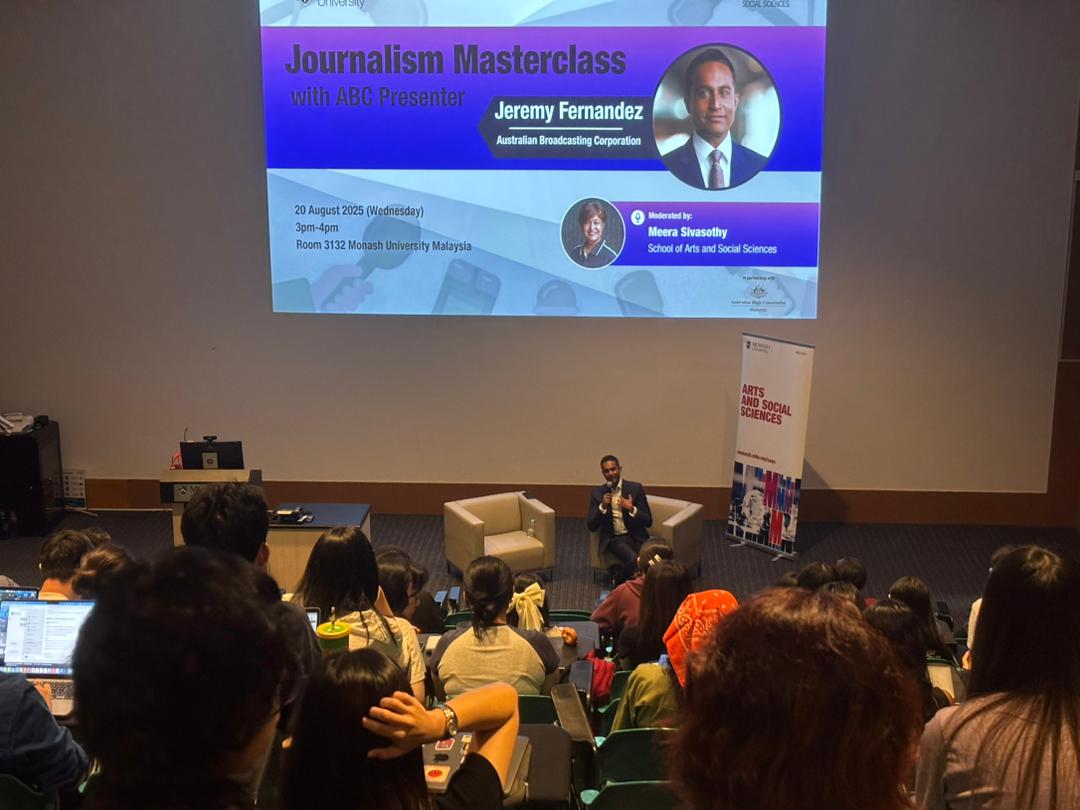
Journalism must be an act of public service
Jeremy Fernandez, a seasoned Australian Broadcasting Corporation (ABC) presenter, urges aspiring journalists to adopt a public service mindset and maintain impartiality to navigate a media landscape pressured by political and commercial interests, as well as online polarisation.
Speaking at a Monash University Malaysia masterclass, Fernandez emphasised that a journalist’s primary duty is to the public, a principle he operates under through ABC Australia’s public ownership model.
Fernandez distinguished between government funding and control, citing the ABC Australia model as a key example.
“We are funded by the government. We are not owned by the government. We are owned by the public,” Fernandez stated.
“The ABC’s mission is to serve the public, not to serve the government.”
He explained that this model obligates the organisation to test government policies and withstand pressure from special interests, a crucial function for upholding democracy.
Moving from the institutional to the individual, Fernandez stressed that a journalist’s core function must be service, not the pursuit of fame.
“Always look at journalism as an act of public service,” he said, cautioning that the on-air role is just the tip of the iceberg. Reading the news, which is what people know me for, is about five percent of my job. Most of my job is actually researching and writing and then interviewing people and preparing for all of that.”
To maintain objectivity and personal resilience, he advised students to separate their professional duties from their private identity.
“I try really hard to actually disengage my personality and my character… from what I do professionally,” Fernandez shared.
Fernandez, who is also a producer, addressed the intense and hostile online environment, warning students not to mistake it for the real world.
“I feel there’s a distortion of what normal is,” he said, arguing that online platforms reward extreme views while the public is often more moderate. “I don’t think the online space is actually a true reflection of where we are as a society.”
To combat this and avoid echo chambers, he stressed the importance of consuming media widely and critically.
He advised consuming information from diverse global sources—citing his own practice of reading outlets from Al Jazeera to the Times of Israel—to understand the “particular interests or cultural lenses” at play before forming a conclusion.
Fernandez also reminded students that all great reporting starts at home: “You can’t cover world news if you can’t cover local news.”

Credit photos: The School of Arts and Social Sciences, Monash University Malaysia.